
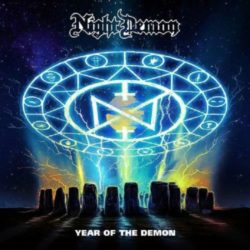
ALBUM REVIEW: Year Of The Demon – Night Demon
It feels quite apt that, in the week where IRON MAIDEN‘s third album The Number Of The Beast celebrates its 40th birthday, one of the torchbearers for the classic NWOBHM revival that…
Read more »
MESHUGGAH's TOMAS HAAKE Says It Took Him Two Years To Find 'Right Person' To Help Him With His Skin Condition
MESHUGGAH drummer Tomas Haake has opened up about the skin condition on his hands that caused the postponement of the band’s previously announced U.S. tour, originally planned for early 2022. Speaking to Metal Injection, he said (as transcribed by BLABBERMOUTH.NET): “I had this problem. It started two years ago. In January of 2020, I started getting eczema on the inside of my hands. Obviously, ‘perfect’ for a drummer — I mean, it’s ‘perfect’ for anyone, ’cause we all need our hands to function for just day-to-day life. So it’s not just about an annoying thing to play drums and to have this condition; it’s annoying for everything you do. And I’m probably one of the few people on earth that did not put alcohol [hand sanitizer] on my hands at all once during the whole pandemic thing, because I basically couldn’t; I would have probably fainted. ‘Cause I used to have all these cracks and stuff in my hands because of this skin condition. But it’s actually, yes, it’s getting better, and — knock on wood — over the last week it’s been getting a lot better. And hopefully it’s going the right way.”
Haake went on to discuss in detail the treatment that he has been receiving in his battle with hand eczema, saying: “I talked to a nutritionist, actually. ‘Cause I’ve been to all the… I don’t know how many doctors and places I’ve been to since this started, and we’ve done all the tests that you can do as far as contact eczema and on your back, all those patches and stuff like that — I did that twice. And I went to a psoriasis place — they thought initially that it was psoriasis related — so I had 30 sessions of UV light kind of sessions for my hands. Nothing helped; nothing had done anything. So a buddy of mine, a drummer buddy here in Stockholm, suggested I talk to this guy that he knew who is a nutritionist for one of the soccer teams here in Stockholm. And so I called him up and we spoke, like, probably about an hour and a half and I described how it all started and what kind of life I live and all that stuff. And he basically told me, ‘Start eating Q10, coenzyme Q10 (CoQ10), because I think there might be something there. You’re not producing this stuff enough, and that will have an effect.’ ‘Cause I also started losing my hair and stuff like that way faster than I had been. So I figured this is connected. And I’ve known, or felt, all along that this was not contact allergy related at all, because I tried everything. I used these cotton gloves for months on end. As soon as I was touching anything, like as far as keyboard mouse, anything that you would come in touch with on a daily basis, I was using gloves and it didn’t do any difference either. So my belief was always more that it’s internal something. And actually after now — this is day number five or six of taking Q10, and it’s way, way better. So, knock on wood, but if it keeps going like this, it’s definitely going the right way, for sure.”
Asked how he first realized something was wrong, Haake said: “I remember we were at a hotel in Venice Beach [California] right after the NAMM show of 2020, and we were watching movies in bed and I was holding this tablet of mine that had like a foldout thing, so I was holding that for a few hours. And the day after, it actually started. It started like a contact eczema right in those points where I’d been holding this tablet. So it just started on my two index fingers and my thumbs. But over time, it changed into something else and it started spreading all over my hands and stuff. So it went from maybe it started because of something going on with my immune system or something — maybe it started as a contact eczema; that was the triggering thing — but then it was something else that made it not go away but turn into this monster inside my hands.”
According to Haake, what made his skin condition especially “scary” was the fact that it meant that “apart from when we rehearsed for the [upcoming MESHUGGAH] album, which would have been maybe a month that we rehearsed before the album and then actually recording the album, I haven’t really played any drums at all since August 2019. Because to play, I have to really severely tape all my fingers and thumbs and I have to put both hands into gloves and then use grip tape on both sticks,” he explained. “And I have been using a stickwrap thing on the right stick and a glove on my right hand for a bunch of years, but that’s more to relax my arm and not use so much force to kind of hold on to the stick. I started doing that more for kind of ergonomic reasons than anything else. But this now turned into something I have to really, really, really tape everything up. The scary part is it’s one thing to do that when you’re in rehearsal and you can just [say], ‘Stop, stop stop. I’ve gotta retape this.’ And the same in this studio — you can take whatever time you need. But to go out and play live for an hour and a half, obviously, it’s not gonna work. You can’t just stop the show and tape up your hands. So, of course, it’s been kind of scary… I really [tried] to remain positive and not just go dark over the whole thing. And I didn’t. I really kind of just — not ‘shrugged’ it off is the wrong word, because I did go to see a lot of different people and dermatologists and doctors and stuff.”
Haake also criticized the level of basic services he received from the health care professionals in his home country of Sweden, saying he required more specialized medical measures than what was available through primary care.
“The problem — it’s a little annoying — is that general care [in Sweden], when you go to a hospital and stuff, unless you really pay a shit-ton of money to go see people that will care about you properly because you pay them to care about you, regular care at a hospital, they won’t really look at everything that you tell them,” he said. “They have their certain way of, like, ‘Yeah, but we do these tests like this because this is how we do them. We go through this test.’ I tell them, ‘We don’t have to do that because I know it’s not that.’ ‘Yeah, but we do it like this,’ and you have to either accept that or you have to go somewhere else and pay your way for every little thing. And just like in the U.S., if you go that route — you can here — but just like in the States, it would be insanely expensive. But it is a little annoying that they don’t really look at it holistically. It was not really much interest or talks about the kind of life I live, what I eat, what I could be missing, if there’s something that’s missing and stuff like that. Yeah, that’s a little annoying sometimes in this case. And if nothing else, it’s what made it take two years before I talked to the right person about this. At least that’s how it feels now, because right off the bat, he was, like, ‘This is internal. I promise you it’s internal. You’re lacking something that makes… You don’t have the repairing. The firefighters are gone. They’re not going to your hands to repair it. And that’s usually then something internally.'”
MESHUGGAH’s ninth studio album, “Immutable”, will be released on April 1 via Atomic Fire. The follow-up to 2016’s “The Violent Sleep Of Reason” was recorded at Sweetspot Studios in Halmstad, Sweden; mixed by Rickard Bengtsson and Staffan Karlsson; and mastered by multiple Grammy Award winner Vlado Meller (METALLICA, RAGE AGAINST THE MACHINE, RED HOT CHILI PEPPERS, SYSTEM OF A DOWN). Visionary artist Luminokaya once again created the cover artwork.
Read more »
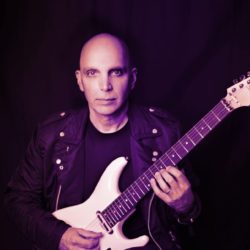
Joe Satriani: The Sound of Solitude
“Don’t ever think that you’re going to impress people by reminding them that you can play faster, stretch your fingers longer, be louder, and look cooler,” says Joe Satriani. Those words carry a lot of weight coming from Satch, who can, of course, do all those things. But while he’s received plenty of attention for his endless supply of dexterous digital athletics over the years, he’s always been a committed melody player. And if you ask him, that’s even harder to dish out.“The songs that sound like they don’t have a lot of technique are actually the hardest ones to play,” he admits. “And the ones that people think showcase the most amount of technique are actually the easiest to practice and perform.”Satriani has long understood that guitarists cannot live on shred alone. With the release of his 18th studio album, The Elephants of Mars, he proves himself a living example of this message, showcasing the electric guitar as a lyrical, emotionally attuned instrument that can exist on a chromatic spectrum of senses—particularly when it’s in the right hands. The album covers a range of ground, from the Middle Eastern-influenced “Sahara”—whose release was accompanied by a music video directed by Satriani’s son ZZ—to the melancholic ballad “Faceless” to “Dance of the Spores,” which features a full-on circus music breakdown.Joe Satriani “Sahara” (Official Music Video)Having an extensive body of work makes it that much harder for some players to keep things fresh, but Satriani pulls it off. For Elephants, he decided to use the isolation of the early pandemic to focus creatively and give remote recording a shot, calling upon bandmates bassist Bryan Beller, drummer Kenny Aronoff, and keyboardist Rai Thistlethwayte to contribute.When Satriani’s previous album, Shapeshifting, was released in April 2020, he and his team imagined that its promotional tour would be postponed for about three to six months. He considered recording a vocal album to offer as a free supplement, but months later the world was still on hold—and he realized that his audience would be expecting an entirely new project the next time he was to release something. So, he got to work on what would eventually become Elephants.“I’m always a bit shy around people and it gets reflected in how I play.”The remote recording experience created a significant change of pace. “For the last couple of records, I really enjoyed going to the studio, having the clock on the wall ticking fast,” he shares. “In a way, having a schedule is good; it just gets you motivated to work hard. If everybody’s stuck at home and there’s no clock on the wall, then we can’t use that as an excuse anymore. Now it’s just you listening to your performance, and it comes down to whether you’re going to stand behind it.”As the guitarist became more patient and considered, he asked his band to do the same, telling them, “I’m not going to send you anything until I think it’s the best version that I can give you, and I expect everyone else to take their time. Don’t feel pressured by me to just get it done. And if you want to do something different, change my mind with a great performance.”That freed the instrumentalists from the restraints of both time and peer pressure, and for Satriani, performing all his parts in solitude yielded a more peaceful creative process: “[If I hadn’t been recording alone,] I never would have felt that vulnerable or comfortable. I’m always a bit shy around people and it gets reflected in how I play, so this setup worked for me in a way that it’d never worked before.”“Guitars are made of wood and wood comes out of the ground, so you have only so much control; nature really has most of it.”But wouldn’t that environment, free from time constraints, give way to extreme perfectionism? Not if you set rules for yourself, Satriani says. His solution was to remind himself not to “sit there and fix everything,” but rather to make sure he was tuned in to the moods of the tracks he was recording. He was sure that if he wasn’t having fun while recording the upbeat, bass- and synth-driven “Pumpin’” or the funk-infused “Blue Foot Groovy,” the music would bore his audience. And on “Dance of the Spores,” he immersed himself in pure fantasy. “I came up with this idea where, while we’re worried about politics and the virus and the environment and all this kind of stuff, there are spores having parties because everything’s great for them,” Satriani muses. “Like SpongeBob: It’s so insane, it’s so impossible, and yet it’s so funny and sad and cute. Everything about life is in that absolutely ridiculous concept. So, what would that sound like?”Joe Satriani’s GearGuitarsIbanez AR3212 12-string electricIbanez JS1CR No. 3Ibanez JS2480 MCR No. 2Ibanez JS2450 B&W Paisley prototype No. 1Ibanez JS2 Gold Chrome Hum-Sing-Sing prototype (1989)Ibanez JS Sing-Sing-Sing Blue prototype (2005)Ibanez JS6 Style 7 String prototype No. 1 (2001)Jerry Jones Electric Sitar (1997)Ibanez JSA20 Acoustic prototype No. 1 (2012)Martin HD-28E Retro (2014)AmpsAvid SansAmp plug-inEffectsTC Electronic Sub ‘N’ Up OctaverEHX Micro Q-TronDunlop Hendrix ’69 Psych Series Octavio FuzzVOX BBW wahPalmer Y-Box splitterStrings & PicksExtra heavy celluloid picksD’Addario .010 setsOn the other end of the emotional spectrum, Satriani spent days repeatedly trying to embody the grief he wanted to convey on the darker “Desolation.” Finally, unrehearsed and unpracticed, he improvised something that fit perfectly. “I never would have done that had we been in a studio with people standing around,” he says.Since around 1999, Satriani’s standard protocol for tracking has been to record direct and reamp later. But this time around, reamping “seemed to get rid of a certain percentage of my personality and replace it with ‘general electric guitar.’” Instead, mixing engineer Greg Koller employed the Avid SansAmp plug-in to the guitar tracks for the entire album.“I’m not sure if that’s a letting go of ego or just realizing your place in the big scheme of things. But I had to realize that it wasn’t all about me.”“I plugged into a Millennia Media HV-37 Mic Pre and went right into Pro Tools,” Satriani elaborates. “A couple of times there was a wah-wah pedal, a [TC Electronic] Sub ‘N’ Up, a [Dunlop Hendrix ’69 Psych Series] Octavio Fuzz, or an [Electro-Harmonix] Micro Q-Tron. And that was it!”If you’ve read Satriani’s autobiography, Strange Beautiful Music, you know that the guitarist is obsessed with gear. He spends several chapters—each devoted to the making of a different album—sharing every technical approach and gear combination that went into each recording. When asked about his signature guitars, he’s a bit Zen. “Guitars are made of wood,” he says, “and wood comes out of the ground, so you have only so much control; nature really has most of it.”But that hasn’t stopped him from refining the design of his signature models over the years. “All these changes that I’ve requested and that Ibanez made really did help me bring my music forward to a higher level of expression.” Picking up his Ibanez JS2450 B&W Paisley Proto, Satriani points out some of those refinements: “the height of the bridge, the fact that the edge bridge is such a well-made machine piece, the Satchur8 pickup, the size of the frets, and the fact that Ibanez now stock puts in the Sustainiac in the bridge position. It’s a 24-fret model, with a compound-radius neck. Everything about this guitar helps me express myself, and I’m still working on it. I’ve never changed my pursuit of trying to make the guitar less resistant to my musical ideas. I feel more like I have so much to say, and my body just will not cooperate to let me get it out properly,” he says, laughing.Satriani has been searching for ways to express his ideas ever since his early days growing up in Westbury, Long Island, where he not only dedicated himself to his music, but to sharing what he’d learned by modeling his educator mother, Katherine, and, at the age of 15, famously teaching a young Steve Vai. “I realized everything that my mother learned in life she hands over—without holding anything back—to these kids that she’s teaching,” he explains. “So that’s what I should do for this little Steve Vai kid who’s just got these amazing hands, great timing, and really sharp ears. I’m not sure if that’s a letting go of ego or just realizing your place in the big scheme of things. But I had to realize that it wasn’t all about me.”“Playing a ballad with a few notes and making every note count—that is a skinny mountain road and any variation is death. You’re plunging off the road into ultimate failure.”That concept still permeates his music. It comes back to expression of melody, and Satriani cites Tony Bennett as an inspiration for knowing when to pause or use fewer notes. “The amount of technique that he has to use to nail it is far more intensive. He has to edit every little bit,” he says. “It’s not like playing your fastest and sticking your tongue out and running around the stage. That’s the easy part. That is a six-lane highway with no lines on it. But playing a ballad with a few notes and making every note count—that is a skinny mountain road and any variation is death. You’re plunging off the road into ultimate failure.”Authenticity and humility are at the heart of making truly meaningful art, and, speaking with Satriani, it’s clear that those ideals are deeply entwined with what he does. He’s a dedicated practitioner who is still growing, learning, and sharing. “This only works if you give it away,” he adds. “You can’t make people think about your music the way you thought about it—it becomes theirs. When they hear it, it becomes the soundtrack to something in their life. And it’s got nothing to do with you, ’cause you’ve given it away.”Joe Satriani – Always with Me, Always with You (from Satriani LIVE!)No song better exemplifies Joe Satriani’s penchant for expressive melodic leads as his classic “Always with Me, Always with You” from Surfing with the Alien. This 2006 performance features all the slick moves of the original with an extra dose of live energy.
Read more » Red Hot Chili Peppers dial back the tempo on dreamy new ballad, Not the One
The third single from the band’s forthcoming album, Unlimited Love, shows John Frusciante’s textural side
Read more » Best Strat-style guitars 2022: 10 Strat-inspired models for all budgets and players
Don’t want a Fender? Here’s our expert pick of the top Strat-style electric guitars from the likes of Ibanez, Yamaha, G&L, PRS and more
Read more »
ALBUM REVIEW: Parrhesia – Animals As Leaders
On the list of bands that need no introduction, ANIMALS AS LEADERS rank pretty close to the top. They have been spewing out iconic technical metal records for over a…
Read more » Robin Trower releases blistering new track, The Razor’s Edge
The blues-rock legend describes the song as “some of my favorite guitar work I’ve played on a recording in a long time”
Read more »
STONE SOUR's JOSH RAND Is 'Excited' About Debut THE L.I.F.E. PROJECT Live Performance
THE L.I.F.E. PROJECT, the musical meeting of minds between Grammy-nominated STONE SOUR guitarist Josh Rand and PARALANDRA vocalist/guitarist Casandra Carson, will make its live debut on April 30 at The Riff in Springfield, Missouri. Support at the gig will come from THE MANY COLORED DEATH and ETCHED IN EMBERS.
In a new interview with HardDrive Radio’s Lou Brutus, Rand stated about THE L.I.F.E. PROJECT (as transcribed by BLABBERMOUTH.NET): “In a sense, it was just something that I started doing a couple of years ago, just writing music myself. And then I just decided I wanted to get a female vocalist, basically, to work on these songs and sing on them. And I found Casandra through a mutual friend — actually, STONE SOUR’s A&R person, Dave Rath — and we hit it off. And then we’ve just been working on stuff for the last two years kind of just here and there. Obviously, with COVID and all that stuff going on in the world, it really restricted going out, so there’s really not been a desire to do that up until recently. So now we’re gonna end up being a full band and actually play our first show April 30th in Springfield, Missouri, which I’m really excited about finally getting back out there. ‘Cause for me, it’s been a bit, I guess — like, three years — since I’ve been on a stage.
“So, that’s really what it’s about,” he continued. “It’s just me musically trying different stuff, but also getting back to where I originally came from, as far as my musical journey. So it’s kind of getting back to my roots and just having fun with it. That’s what THE L.I.F.E. PROJECT is for me — it’s a different vehicle to express myself, I guess, artistically with truly no boundaries, but leaning more towards, musically, I think, coming at it as an educated teenager. What I mean by that is it’s the fire of that teenager — that drive, that style of music that I was playing 30 years ago — but now doing it with the experience, the knowledge and all that. So it’s kind of like revisiting the past, in a way, or going home in some ways.”
THE L.I.F.E. PROJECT released a new four-song EP, titled “Big F.O.U.R.”, on March 18 via Bloodblast. The collection features a clutch of cover versions, one each from heavy music’s pioneering icons METALLICA, SLAYER, MEGADETH and ANTHRAX.
Rand previously stated about the EP: “Recording a ‘Big F.O.U.R.’ cover EP is something that I have wanted to do for a very very long time, and last fall I decided to finally do it with THE L.I.F.E. PROJECT.
“Without these four bands (METALLICA, MEGADETH, ANTHRAX and SLAYER), my musical career wouldn’t be where it is today. In some ways, you could say this project is paying homage to them or, how I see it, a return to where it all started in my parents’ house as a teenager trying to learn just a piece of the music.
“Each of the four songs that I picked were pivotal in my development as a musician, whether it was learning the intro to ‘One’ on guitar, drums on ‘Symphony [Of Destruction]’ or bass lines in ‘Caught In A Mosh’.
“This EP was a true love and passion project for myself. I feel I captured the vibe and the spirit of the original but with THE L.I.F.E. PROJECT sound. Hopefully you hear it too!”
Stylistically, THE L.I.F.E. PROJECT is a fluid combination of classic metal sensibility and Rand’s penchant for pushing the boundaries of contemporary heavy.
THE L.I.F.E. PROJECT’s debut self-titled EP came out last summer and is available exclusively through the band’s webstore or via the Nuclear Blast store.
Josh and Casandra’s debut single, “The Nothingness”, was featured on several major playlists across streaming platforms, including Rock Hard on Spotify, Breaking Metal on Apple Music, Break Through Rock on Amazon and Metal Radar on Deezer. “The Nothingness” was also included on SiriusXM Octane’s “Test Drive” show on release.
Read more »