

Def Leppard announce first new studio album in seven years, Diamond Star Halos, premiere catchy lead single, Kick
Set for release in May, the 15-track effort features a pair of guest appearances from bluegrass/country legend Alison Krauss
Read more »
Sue Foley: Pinky Don’t Play No Mess
For Austin, Texas’ favorite Canadian expat, guitarist, and singer Sue Foley, staying faithful to the blues tradition is more than just a concern of style. It’s a calling. Foley explains: “I never questioned really dedicating myself to the blues, and that commitment and desire to always be true to it has never changed. I can see where the lines have been blurred between blues, Americana, and country, and there’s a million ways you can skin a cat at this point, but for me and my perception of what the blues really is, you have to step into a history and a deep tradition.”With her latest release, Pinky’s Blues, Foley doubles down on that assertion while adding a fresh document to Austin’s fabled blues catalog. The album’s obscure song selections flex Foley’s muscles as a historian and student of the form, but also provide a fabulous platform for her tremendous personality and chops as a guitarist and vocalist. The album, which was named after her beloved late-’80s pink paisley Fender Telecaster, “Pinky,” is Foley’s 16th release as a leader and a love letter to the forgotten but influential deep cuts that helped shape the Austin blues sound as we know it.“We really handpicked these tracks of favorites between me and our producer Mike Flanigin. These are all songs that, when we were coming up, you kind of had to know to get in the club, so to speak. Something like Clarence ‘Gatemouth’ Brown’s ‘Okie Dokie Stomp’ was a rite of passage for any guitar player in Austin back then. Now, you never hear anyone doing it, but it was a regular song that everyone had to know.”Pinky’s BluesFoley earned her stripes in the blues world the old-fashioned way. After starting to find her voice on guitar in her native Canada, she grew enamored of the blues and specifically the sounds coming out of Austin. Foley relocated to the hip Texas city in the early ’90s to immerse herself in the local blues culture. In an era before the internet gave us infinite access to all things, Foley’s Texas pilgrimage wasn’t just a drastic way to soak up the music. It was the most authentic way. Foley ruminates on that magical, pre-internet era.“It’s completely different now! I have a 24-year-old son that’s a musician, and the way he is able to view and experience music is totally different from what we did. It’s still really valid, but it’s just a different vibe. What I saw and experienced was all direct transmission, and that honestly had to be experienced directly. I had to stand in front of Albert Collins’ amp to get the full effect! I had to have part of my hearing destroyed and I had to move molecules. I think direct transmission like that is important and you just can’t get that from the internet.”“Let’s face it, Howlin’ Wolf wasn’t in there splicing together his vocal takes.”Foley continues: “I can talk about Albert Collins, but unless you stood in front of his amp and watched him, you can’t really get it. You can watch all the clips of him you like and say, ‘Well, yeah, he had a wicked tone,’ but when that tone hit your ears in person, I’m telling you it split your hairs! That shit was real and that shit changed my life. I’m not sure if I was just starting out today if I’d even be a blues musician, because I wouldn’t have seen all of these people live. It was experiencing that face-to-face and walking away with my jaw dropped that changed my life and expanded my spirit and my soul, and I’m not sure I could do that watching a YouTube video.”The years Foley spent worshiping in front of the amplifiers of (and eventually sitting in with) greats like Collins, Brown, Billy Gibbons, and Jimmie Vaughan helped her shape a style that’s undeniably authentic and traditional, but defined by an impressively vocal phrasing approach that gives her playing its own special personality. From the soulful, improvised instrumental title track and album opener to the brasher rave-ups (“Dallas Man” and “Okie Dokie Stomp”), Foley’s singing and guitar playing is timeless and familiar, yet entirely her own. From her tones to her note choices, she tends to favor understatement fueled by palpable conviction.Sue Foley’s GearGuitar1988 Fender MIJ ’70s Paisley Telecaster Reissue named PinkyStrings & PicksD’Addario strings (.010–.046)Golden Gate small thumbpicksAmpEarly ’90s Fender 1959 Bassman 4×10 reissueEffectsBoss Digital ReverbStrymon FlintIn the spirit of capturing as live and visceral an experience as possible, Pinky’s Blues was cut in just three days by Foley and her band (which included drummer Chris “Whipper” Layton of Stevie Ray Vaughan and Double Trouble/Arc Angels fame, and a guest appearance from Jimmie Vaughan himself) playing in the same room—including all the amps. There was no pre-production involved and the musicians went in with only a cursory knowledge of the songs—something Foley believes added a lot to the album’s undeniable spark and energy.“Everything was done live, everything was played together in the studio, including the vocals,” Foley relates. “No overdubs. I was just getting comfortable with a few of the songs. Chris Layton is obviously a wizard and can just play anything, and Jon Penner was my very first bass player and he’s back in my band now. So, it was a bunch of really skilled musicians and what we do is live music, so none of us were intimidated by the process. We just went for it! That’s how all our favorite albums were cut! Let’s face it, Howlin’ Wolf wasn’t in there splicing together his vocal takes.”From Foley’s perspective, deliberately shirking any rehearsal of the tunes on Pinky’s Blues forced her and her band to really listen to one another as they tracked. “Everyone was really in the moment, and that spontaneity and energy is what you’re hearing on the album. And the reason this album sounds so good is the bleed, because we had so many room mics and we were all in one big room. It was set up like a live show and we just hit record, so we were getting the drums in the vocal mics, the vocals in the guitar mics, and that bleed created this big, cohesive sound. Our engineer, Chris Bell, worked hard to get those sounds right, and I know he had challenges mixing the album because everything is going into everything. You want a blues record to be a little on the edge, you know?”When asked what legendary drummer and longtime friend Layton brought to the fold beyond his signature deep pocket and greasy backbeat, Foley is quick to call out his fantastic playing on “Southern Men,” and tells PG the tune was a deep cut that was dug up from an obscure ’70s compilation album called Blues in D Natural. “I’ve had it in my vinyl collection from way back, and Chris Layton had that same compilation and showed it to Stevie [Ray Vaughan] and they cut [Sly Williams’] ‘Boot Hill’ off that album. The original version [by Georgia-based bluesman Tommy Brown] was called ‘Southern Women,’ but we did it as ‘Southern Men.’”All players hit a rut occasionally, and when Foley found herself in the 6-string doldrums, she turned to flamenco guitar to shake things up. Foley believes the picking hand is where the magic of a player’s personality really comes through, and as a player with a fixation on picking techniques, flamenco offered her a buffet of new techniques and a completely alien playing experience. Foley, who favors a thumbpick and acrylic nails on her right hand, says, “I used to watch Gatemouth, and his picking hand had this magic thing to it. He had unique things he was able to do. I took flamenco lessons because there happened to be a teacher in town, and it really turned me on my ear. It was literally like I had never played the instrument before, and I had been playing for almost 20 years at that point. It was very humbling. I took a year or two of those lessons and I applied those techniques to some kind of hybrid-blues form. I love playing my nylon-string guitar, and flamenco and blues are very sympatico art forms in my opinion. I think a lot of your tone comes out of the picking hand and I think you get more special elements out of your playing if you focus on that side of your playing a bit more.”“These days, the whole loud guitar and amplifier thing isn’t the most popular thing, but it still is for me, and I love it. It’s a feeling of power!”Much like her heroes, Foley favors a lone guitar and a spartan rig. The entire album was tracked with Foley’s paisley Telecaster named Pinky, which is a stock MIJ reissue that she fell in love with and got new in 1988. “I saw it and thought, ‘I have to have that!’ and my boyfriend at the time brought it home for Christmas and had made the first payment, but I paid it off in installments,” Foley says of Pinky’s origins. “I’ve played that guitar at every show, recorded every album, and done every tour with it for 30-something years now. It’s got a lot of miles and it still sounds great. I’ve never changed the pickups, but I’ve had it refretted a few times. I’ve always loved the neck and it’s always sounded so good that I’ve just never wanted to mess with it!”Pinky sang through an early ’90s 1959 Fender Bassman reissue on the album, which Foley bought new. The guitarist says that she’s never felt the need to be particularly adventurous about gear, because “you can dress everything up, but at the end of the day, you’re still you and you’re going to sound like you. When I saw Albert Collins, he only ever had one guitar. When I saw Gatemouth, he almost always played the same one.” However, Foley does make an exception for reverb, which she loves, and called upon a Boss Digital Reverb and a Strymon Flint to add some atmosphere to her cranked Bassman.Beyond her killer new album, Foley’s many years in the game—coupled with a dedication to studying the blues tradition with an academic approach—has afforded her a unique perspective. While she’s a staunch proponent of preservation, Foley makes no bones about the fact that to keep the blues alive “you have to breathe new life into it, you’ve got to be yourself, and you’ve got to tell your story. There’s a whole bunch of things you can add into it that bring this tradition forward and into the current times, but it’s about your personal story and nobody can take that away from you. That’s where your blues begins and ends, really!”Foley’s lengthy career has brought her shoulder-to-shoulder with some of the greatest guitarists the genre has ever produced—experiences she says were not just wildly validating but provided the perfect opportunity to steal from the best. “You can learn some of their tricks because you’re seeing them up close and getting a feel for the little special things that everybody incorporates in their stuff that might not be immediately apparent,” she notes. “I’ve played with Jimmie [Vaughan] a lot, and he’s got a lot of little special things that he does to make up his secret sauce, so there’s that. That osmosis and direct transfer and those magical things that shoot right into your spirit when you’re getting them from an amp and a guitar … that’s what it’s all about for me. These days, the whole loud guitar and amplifier thing isn’t the most popular thing, but it still is for me, and I love it. It’s a feeling of power!”And while many of the great blues players that shaped her love of the genre have now passed on, Foley still appreciates the style’s capacity for reverence and respect for its elders more than anything: “When I was coming up, we toured with every blues artist that was on the scene, from Buddy Guy to Koko Taylor. Most of them were a lot older, but there was a real reverence for that age and a real respect, and I just love that about the blues. You can grow up in it, grow old in it, and get better! To me, that was always the beauty of blues music: When you get older, you kind of get better. It’s such an age-obsessed, youth-obsessed world these days and when you see an art form like this that not only really appreciates age, but you kind of have to have some years in the game to be the real deal … it’s rare.”Sue Foley – Live in Europe DVDChock full of perfect-blues-tone guitar solos, this live concert from Köln Germany captures Sue Foley relatively early in her relationship with Pinky, her paisley Telecaster. It also reveals how deeply her playing is rooted in Austin’s blues legacy.
Read more »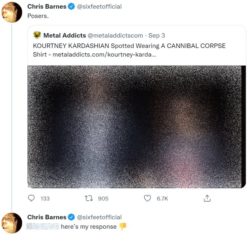
TRAVIS BARKER On KOURTNEY KARDASHIAN's CANNIBAL CORPSE Shirt Controversy: 'That's The Lamest S**t Ever'
BLINK-182 drummer Travis Barker says it was “the lamest shit ever” for former CANNIBAL CORPSE singer Chris Barnes and others to criticize Kourtney Kardashian after the reality TV personality and social media star was photographed wearing one of CANNIBAL CORPSE’s t-shirts.
In the widely circulated photo, Kardashian is seen sporting an “Eaten Back To Life”-era long-sleeve T-shirt from the death metal veterans while she and Barker, who is her fiancé, were in Venice for the Dolce & Gabbana show. Her stylist, Dani Michelle, had since confirmed to Vogue that Kourtney borrowed the shirt from Barker, who has a large collection of punk and metal t-shirts. “Kourt has told me before that his closet is an archive itself. She can pick any t-shirt to wear and it’s the softest, coolest thing ever,” Michelle told Vogue. “Sometimes she just wants to raid it.”
Last September, Barnes shared an article about Kourtney’s latest wardrobe choice and he wrote simply: “Posers.” He also tagged Vogue writer Liana Satenstein and wrote in a separate tweet, “here’s my response”, adding a thumbs down emoji to really express his disapproval.
Now, in a new Revolver interview with Barker, the BLINK-182 drummer has chimed in on the controversy, saying: “That’s the lamest shit ever. Obviously my fiancée doesn’t listen to CANNIBAL CORPSE, but I do. I grew up loving them. For [someone] to mention that in a negative light — fucking lame, you know? She’s wearing it because she’s [cool]. She’s not claiming she knows every song. But I do! I bought every album, and I learned how to play every album.
“I grew up a punk-rock kid, [but] everything with punk rock — ‘I’m more punk than you’ — just fuck all that. Be stoked that people are into music. Music is beautiful! It changes people’s lives. It creates the best memories. Just celebrate it, you know?
“But yeah … I have a gang of CANNIBAL CORPSE t-shirts,” he added with a laugh. “I still love them. I have a gang of KING DIAMOND t-shirts and rare SLAYER shirts because I fucking love those bands. I grew up on them. Even though I’m, you know, whatever the world wants to view me as — ‘Oh, that’s BLINK-182’s drummer’ — actually that guy was playing in a garage with a bunch of speed-metal kids listening to D.R.I. and S.O.D. I enjoyed every fucking minute of it.”
Kourtney is just the latest in a growing trend of celebrities wearing heavy metal t-shirts as high fashion. Rapper Kanye West has previously been criticized for repping vintage band tees, and Kourtney’s sister Kim Kardashian is regularly spotted wearing METALLICA t-shirts. Kim’s maternal half-sibling Kendall Jenner was seen getting around in a SLAYER tee, and EXODUS guitarist Gary Holt — who also played with SLAYER for nearly a decade — apparently responded by wearing a t-shirt onstage that read “Kill The Kardashians”.
After Kanye was seen wearing a TESTAMENT t-shirt in 2016, the band’s guitarist Alex Skolnick reacted negatively in an online post, writing: “Goodness gracious. This whole decrepit clan must have picked up a pile of old concert t-shirts (the same pile Kourtney K’s SLAYER shirt came from) which have somehow become a ‘thing’ in trendy fashion (who’d have thought?!!). Inconceivable that any of these pop-culture vultures know who the heck any of the bands are. My guess is he thinks it’s a religious group (not the first time that’s happened). That is, if he thinks at all, which lately seems unlikely. And I thought this time period couldn’t get any weirder…”
Barnes exited CANNIBAL CORPSE in 1995, one year after the release of the band’s “The Bleeding” album. He has since been replaced by George “Corpsegrinder” Fisher.
Photo credit: Jordan Knight
Read more » “All we ever wanted to do in this band is kick people's ass”: The Smashing Pumpkins on '80s Marshalls, epic guitar arrangements and their essential pedals
In this 1995 GW interview, Billy Corgan and James Iha discuss the gear that powered their sprawling, double-disc masterpiece, Mellon Collie and the Infinite Sadness
Read more » Lollar launches Bass VI single-coil pickups
The new set has been designed from the ground up specifically for Fender’s six-string bass, and promises improved balance, increased punchiness and better dynamic response
Read more »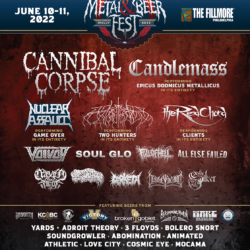
Decibel Magazine Metal & Beer Fest: Philly Welcomes Mocama Beer Company & MNRK Heavy
We’re proud to announce the addition of Florida’s Mocama Beer Company to our pouring brewery lineup and MNRK Heavy to our collection of presenting sponsors for this year’s event on June 10-11 at the Fillmore Philly.
The post Decibel Magazine Metal & Beer Fest: Philly Welcomes Mocama Beer Company & MNRK Heavy appeared first on Decibel Magazine.
Muse announce first album in four years, Will of the People, share ominous new single, Compliance
The English rock trio’s ninth studio album, which is influenced by “increasing uncertainty and instability in the world”, will arrive August 26 via Warner Records
Read more » OVERKILL's New Album Won't Arrive Before April 2023
On March 10, 2022, OVERKILL frontman Bobby “Blitz” Ellsworth was interviewed by Mark Kadzielawa of 69 Faces Of Rock on the band’s tour bus outside The Forge in Joliet, Illinois. Speaking about the progress of the recording sessions for OVERKILL’s 20th studio album, Blitz said (as transcribed by BLABBERMOUTH.NET): “We didn’t record all the parts yet. We like to keep it as fresh as possible. The drums are done; the guitars are done. D.D. [Verni, bass] and I need to sit down and finalize a few things. We’re looking for an April 2023 release, followed by a European tour.”
Asked about the musical direction of the new OVERKILL material, Blitz said: “It’s gonna be hard to figure it out for me until it actually takes shape. It seems a little bit more eclectic for us. It’s riff driven, not rhythm driven. The songs will contain two or three different riffs throughout it — the main [riff] and then two that are kind of secondary riffs, which I think is a little bit unique for us, to be singing over something like that. Heavy, of course. I mean, there’s some sledgehammer stuff on it — that kind of big, thick groove. I think the other side of it is that it shows kind of experienced speed, would be the word. Some of them just take off.”
Back in November 2020, Verni told MetalAsylum.net that OVERKILL’s new LP would be mixed by Colin Richardson. “He did a couple of records for us, and he’s great,” Verni said.
Richardson previously worked with OVERKILL on 1997’s “From The Underground And Below”, 2000’s “Bloodletting” and 2003’s “Killbox 13”.
In June 2020, Ellsworth told A&P Reacts that the band’s new songs were “a natural progression from ‘The Grinding Wheel’ [2017] and ‘The Wings Of War’ [2019]. I think when we had done the ‘Ironbound’ record [2010], it almost became like a trilogy in there — it was kind of like ‘Ironbound’, ‘The Electric Age’ [2012] and ‘White Devil Armory’ [2014], and they seemed to be the Father, Son and the Holy Ghost kind of a thing,” he said. “I think we kind of broke the mold a little bit with ‘The Grinding Wheel’, and then I think a little bit more with ‘The Wings Of War’. And on this one, I see it way more. And what I mean by that is that we’ve used other tools from our toolshed in the past, and that’s the slow grind that is coupled with that fast gallop. So it feels like a natural progression, but maybe two records ahead of what ‘The Wings Of War’ is. And that’s probably as objective as I can be.”
OVERKILL spent most of 2019 and early 2020 touring in support of its 19th studio LP, “The Wings Of War”, which was released three years ago. The disc was recorded at Gear Recording Studio in New Jersey, SKH Studio in Florida and Jrod Productions with engineering handled by Verni and guitarist Dave Linsk. The album was produced by the band while Chris “Zeuss” Harris took care of the mixing and mastering. Travis Smith (NEVERMORE, OPETH, SOILWORK, DEATH) was again enlisted to create the artwork for the album.
“The Wings Of War” marked OVERKILL’s recording debut with drummer Jason Bittner (SHADOWS FALL, FLOTSAM AND JETSAM), who joined the band in 2017.
Last month, Blitz confirmed that guitarist Dave Linsk is sitting out OVERKILL’s current U.S. tour due to “personal reasons” and is being temporarily replaced by former MACHINE HEAD and current VIO-LENCE guitarist Phil Demmel.
Read more » HEART's ANN WILSON Offered To Front New Band Featuring LED ZEPPELIN Members: 'I Threw My Hat In The Ring'
HEART’s Ann Wilson says that she offered to audition to become the vocalist of a new project featuring LED ZEPPELIN members.
Back in 2008, Jimmy Page and John Paul Jones were looking for a way to keep working following LED ZEPPELIN’s incredible one-off performance at the O2 Arena in London in December 2007.
Although there were rumors of staggering sums being offered to the group for a full tour, singer Robert Plant elected to continue with his solo career instead.
Page has not divulged the full list of singers who jammed with him, Jones and drummer Jason Bonham, but ALTER BRIDGE frontman Myles Kennedy has publicly acknowledged rehearsing with the group, as has AEROSMITH’s Steven Tyler.
Now, in a new interview with Liz Barnes, host of Planet Rock ‘s “My Planet Rocks”, Ann revealed that she “threw [her] hat in the ring” when she heard Page and Jones were looking for a new singer almost 15 years ago. She made the comment while discussing “The Battle Of Evermore”, the only LED ZEPPELIN track to feature a guest vocalist.
“Yeah, it’s such a boy’s club,” Ann said. “ZEPPELIN always was a boy’s club. I know that because there was a minute when the rumor was that they were auditioning singers and I just threw my hat in the ring. I went, ‘I’m here!’ and it was crickets,” she added, using the term that means absolute silence or no communication.
When Liz commented that LED ZEPPELIN should have at least said, “Come on in, Ann, and let’s do a few numbers”, Ann responded: “Who knows what went on there? But anyway, who would want to hire somebody that could sing just like Plant? I don’t think that’s what they were into, you know? I don’t think they want it to be a caricature of LED ZEPPELIN.”
Back in December 2012, Ann and her sister, HEART guitarist Nancy Wilson, delivered a moving rendition of “Stairway To Heaven”, LED ZEPPELIN’s signature song, at the Kennedy Center Honors. They were joined by Jason Bonham, son of original drummer John and the drummer for LED ZEPPELIN’s 2007 reunion show. Their version of the track gradually grew to include a string section, a horde of backup singers and the Joyce Garrett Youth Choir. Page, Plant and Jones sat watching from the balcony and were visibly moved, particularly Plant, who had tears welling up in his eyes.
Despite the fact that both Tyler and Kennedy had gone public about their time working with the ZEP members, it seems that the majority of the work was done before any vocalist entered the picture. Back in 2017, Page explained to Classic Rock: “Certainly for Jason, myself, and John Paul Jones; Robert had his Alison Krauss project to promote. It seemed the right thing to go in and start playing new material. I thought we really should play to our strengths here, which was the music. But there were a lot of movements to bring in singers and do this, that and the other. And that would’ve changed the character too early from what we were doing. I won’t say there was pressure, but there was a lot of hinting about this singer and that singer. For me it was more a question of, let’s see what we can really do. And I don’t think we got a chance to do that. Of course we would’ve played LED ZEPPELIN material, but you want to be playing some really, really good new music beforehand.”
Jones added that once it was clear that Plant was not going to be joining the exploratory rehearsals featuring the new material, it was never going to be merely a LED ZEPPELIN project with a new lead singer. “Not at all,” he said. “That’s a total misunderstanding. I said, ‘Of course, if we go out (on the road), we’re going to have to do some ZEPPELIN numbers.’ And there’s nothing wrong with that. In fact, we rehearsed ‘Carouselambra’ (from ‘In Through The Out Door’), which we’ve never done live before, and we had a bunch of new material done. But Jimmy and I couldn’t agree on singers. . . I quite liked Myles Kennedy. He’s got the range, but his voice is completely different than Robert’s. Which was fine by me, because it was going to be a completely different band. But it didn’t work out and we all moved on.”
Read more »