
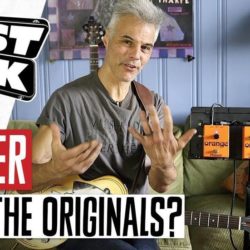
First Look: Orange Distortion, Sustain & Phaser Pedals
Wayback machine voyagers return with beautiful, re-energized, and super-sounding relics from the hidden corners of Orange’s vaults.
Read more »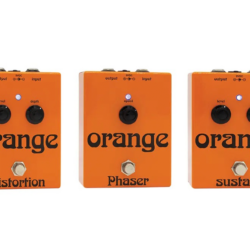
Orange Phaser, Sustain, and Distortion Review
Beholding the three new Orange Vintage Series pedals—in all their substantial, Technicolor splendor—it’s hard to believe that they weren’t more successful in their original incarnation. Orange didn’t shift many original Distortion, Phazer, and Sustain units. And these days, when even the most obscure stompbox has been dissected down to the molecular level, little is written about them. Few original specimens pop up for sale, and even Orange itself had to hunt and gather pedals from the guitar community so they could study for this resurrection project.I’m grateful they went to the effort though. The new U.K.-built Orange effects are awesome. They’re stupidly easy to use. They look amazing—pedalboard space be damned. They also sound killer and offer real sonic alternatives to more common old-school-style effects.Each of the Orange Vintage Series pedals are $249, which is not cheap—especially given their simplicity. By they are beautifully made, with tidy through-hole circuit boards, serviceable parts, and quality that rivals or equals what I see in a lot of boutique-class pedals selling for similar prices. They are also beautiful. And I, for one, find inspiration in pedals that are fun to look at—particularly when they sound as good as these.Orange Distortion, Sustain & Phaser Pedal Demos | First LookOrange DistortionWhen the original Orange Distortion appeared in the late ’70s, the delineations between fuzz, booster, overdrive, and distortion were neither clear nor very widely discussed in the greater guitar sphere. Generally, a customer probably went into a store looking for a tool to make their rig sound nastier, tried out a few things, and left with the one they liked best.It’s cool then that this iteration of the Orange Distortion—which, from this trio, deviates most from the original—so adroitly spans so many of those categories. Engineer Ade Emsley didn’t love the sound of the original, so he overhauled the whole circuit. In this iteration, the Orange Distortion is built around a JFET-based amplifier circuit with preset bass and midrange in the tone stack and a treble control that can be adjusted via an internal potentiometer. This shift in design ethos does nothing to diminish the Orange Distortion’s 1970s aura when it’s switched on, however.Full ThrottleLike a few late-1970s circuits—the DOD 250 and MXR Distortion + come to mind—the Orange Distortion’s drive can be hot and aggressive but leave a lot of room for string detail to breathe. The compression inherent in distortion is not too oppressive here, which helps make things sound big and organic. The high-mid voice has a tough Marshall accent that can dish sweet Peter Green-style lead tones. And pretty grinding distortion tones can still feel and sound articulate. The Orange Distortion also excels at the other end of the gain spectrum. It works as a pretty-clean to just-barely-dirty boost that adds lots of extra-explosive life and sparkle to a bridge pickup and lends a Fender amp circuit a just-right dose of Anglo-amp presence and heat.A shift in design ethos does nothing to diminish the Orange Distortion’s 1970s aura when it’s switched on.A few players will want to take advantage of the treble pot on the interior—particularly humbucker players. But while the Curtis Novak Widerange units I used could sound blurry past the first third of the gain range, these tones were still beautiful, liquid stuff. The pedal is also responsive to dynamics, and guitar volume attenuation is effective for coaxing clean tones.The VerdictThough “distortion” may suggest a narrow range of tones, Orange’s Distortion gives you a lot of sounds to work with. The near-clean tones are lively and detailed. The mid-gain tones, meanwhile, are rich and brimming with naturalistic and amp-like saturation characteristics. It’s less claustrophobic than my favorite old RAT 2, more open and meatier than a Klon clone at high gain settings, and responsive to picking and volume dynamics. Classic rock-oriented players will rejoice at the sounds available here, but there are also loads of tones for less stylistically constrained players to explore, from jangly to compressed and fuzzy.Orange PhaserWe are spoiled for phaser choice these days—both in sheer numbers and in the extensive waveform-shaping options you get in newer pedals. In light of these evolutions, it’s easy to forget how limited and primitive early phasers were. The two pillars of phase at the time, the MXR Phase 90 and Electro-Harmonix Small Stone, each had just one knob for modulation rate. Only the latter took the radical step of adding a “color” or phase intensity switch. Orange’s Phaser is built in the manner of these classic units. It exhibits many of the best attributes of both but is intoxicating on its own merits. And like so many great one-knob phasers, it’s deeper and more versatile than you might think.Like both a vintage Small Stone and the Phase 90, the Orange Phaser’s modulations feel and sound extra dimensional.Like the original Phase 90 and Small Stone, the Orange Phaser is a 4-stage phaser circuit, which usually adds up to a sweet spot between intensity and clarity. In the Orange Phaser, that translates to a liquid pulse that’s reminiscent of a favorite vintage Small Stone. It’s a little less vowel-y than my favorite script Phase 90. But like both a vintage Small Stone and the Phase 90, the Orange Phaser’s modulations feel and sound extra dimensional. In the case of the Orange unit, that means a balanced emphasis on low- and high-end frequencies as it cycles through its modulations, which gives it a chewiness and a noticeable sense of size. And for an analog phaser, the Orange is a remarkably quiet pedal. Its low noise floor creates extra clarity and a full-spectrum feel.The VerdictA 4-stage, 1-knob modulator—we’ve heard this tune before, right? Yes and no. The Orange unit is highly reminiscent of vintage Small Stone and Phase 90 sounds. But the low noise floor enhances detail in an already clear-sounding circuit, creating a more vivid picture of the rubbery drag and elasticity that makes a vintage phaser sound so watery and immersive. It may be very old school, but Orange’s phaser still feels like real refinement.Orange Sustain“Sustain” in the case of this new Orange pedal means compression. And this take on vintage optical compression spans familiar and more open-ended sounds and textures. For starters, the Orange Sustain, like the Phaser, adds very little additional noise to your signal, so you can add loads of sustain (via the depth control) and an ample helping of boost (from the level control) without adding an intolerable layer of hiss to your signal.At certain settings (and especially at low volumes), the Sustain feels and sounds a little like the many Ross-derived compressors that appeared in the 1970s. And many players who use a Dyna Comp or other Ross-inspired compressors will find cool equivalent sounds and effects in the middle ranges of the Sustain’s controls. In general though, the Orange’s optical circuitry helps make the Sustain feel much more oxygenated. There’s a lot less speaker-smothered-in-a-blanket squish and obliteration of picking dynamics—even at high sustain levels. For players that like the sonic benefits of super-heavy squish, the absence of these heaviest compression sounds might be a deal breaker. But I suspect most players will love the clear, potent boost and the more subtle squish and sustain this circuit generates.The Orange’s optical circuitry helps make the Sustain feel much more oxygenated.The VerdictThe Orange Sustain, like its sibling pedals in the Vintage Series, inhabits a very cool niche. It’s as simple-to-use and as sonically forgiving as a Dyna Comp—perhaps even more so. But with a well-executed and simple optical circuit, it manages to sound big and transparent almost in the fashion of a studio compressor. Low-compression boost sounds are burly and smooth, thanks, in part, to the optical circuitry. And piling on more sustain and output volume makes things warm and growly. High-squish addicts, or those that like the more brash side of a Ross or Dyna Comp, might find the Orange a little refined. But try plugging one in with a little reverb and a big tube amp cranked up loud … I expect you’ll be psyched.
Read more »
From Ulrich-fueled fuzz riffs to unadulterated raucous rock: here are this week's essential guitar tracks
The freshest cuts from Laura Cox, Taipei Houston, Chris Shiflett, Willow, Alyssa Day, Bush – and more!
Read more » John Mayer channeled every era of his playing into this solo – and it became one of his greatest guest spots ever
The revered outing from 2020 saw Mayer share the stage with David Ryan Harris, Isaiah Sharkey, Terence Clark and Sean Hurley, and the result was something extraordinary
Read more » 60 years of Ernie Ball: the history of a family business that changed the world of guitar and bass as we know it
With the help of Sterling Ball, we unpack the history behind a great American success story
Read more » Erja Lyytinen: “I didn’t want to restrict myself to making radio hits. If the song required a longer guitar solo, I let it happen!”
The Finnish blues-rock guitarist checks in to discuss the evolution of her style, her setup for slide, and why it pays to double up when it comes to pedalboards
Read more »
ALICE COOPER, PAUL RODGERS, MATT SORUM And JOSH HOMME To Perform At 'Rock The Plaza' All-Star Concert
The historic Plaza Theatre in downtown Palm Springs announced that there will be a fundraising concert featuring The Palm Springs All Stars, a stellar lineup of world-class musicians and their rockstar friends. “Rock The Plaza” is a major concert to be performed at the Plaza Theatre in Palm Springs….
Read more »
TIM 'RIPPER' OWENS Says 'People Are Really Gonna Love' His New EP
This past July, former JUDAS PRIEST singer Tim “Ripper” Owens released the official music video for his new solo song “Embattled”. The track, which will appear on Owens’s upcoming EP, was produced by Jamey Jasta (HATEBREED) and Nick Bellmore (JASTA, DEE SNIDER). Players on the effort, which will con…
Read more »
Watch IRON MAIDEN's Entire Concert In Austin During 'Legacy Of The Beast' 2022 Tour
Fan-filmed video of IRON MAIDEN’s September 13 concert at Moody Center in Austin, Texas can be seen below.
As has been the case on all the shows of the 2022 leg of MAIDEN’s “Legacy Of The Beast” world tour so far, the band opened the set with “Senjutsu”, the title track of its latest studio album,…

MEGADETH's DIRK VERBEUREN Pays Tribute To SOILWORK's DAVID ANDERSSON
MEGADETH drummer Dirk Verbeuren has paid tribute to his former bandmate in SOILWORK, guitarist David Andersson, who died earlier this week at the age of 47.
Verbeuren, who had been playing with SOILWORK for more than a decade before joining MEGADETH in 2016 as the replacement for Chris Adler (ex-LAM…