

Despised Icon release new music video for ‘Death Of An Artist’
DESPISED ICON have released a new music video! The new music video, for the track Death Of An Artist, is taken from the Canadian deathcore pioneers’ upcoming seventh full-length album, Shadow…
Read more »
Next up from our Nashville showroom: Elizabeth Cannon and her Player II Modified Tele
Next up from our Nashville showroom: Elizabeth Cannon and her Player II Modified Tele. 🤠🤘 Tag us in your videos for a chance to be featured next. #FenderFeature. #Fender #FenderGuitars…
Read more »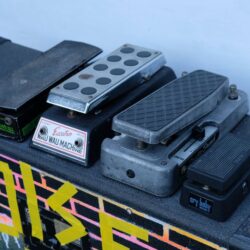
Wah-Wah 101
If you ask me what my favorite pedal is after fuzz, the answer is definitely wah. Bands like Fu Manchu and Dinosaur Jr. are great examples of just how powerful wah, fuzz, and a wall of amps can sound together. Sorry, I’m not into SRV voodoo or those “whacka-whacka” kinds of wah sounds. Let’s dig a little deeper. My very first wah pedal was actually a gift from my ex-girlfriend. She told me it sounded “sexy.” She knew absolutely nothing about guitars. Maybe the sound reminded her of some sleazy ’70s B-movie soundtrack. That pedal was a Dunlop GCB95 with a red Fasel inductor. I absolutely loved it … at first. I even took it out on tour. But I grew to hate it. It was heavy, hard to click on, had no on/off LED, and it sucked tone like crazy. But still, it was the pedal that made me fall in love with wah and start digging deep into its history.Wah is one of the most iconic effects pedals—so iconic that even non-guitarists recognize it instantly by sound alone. Hence the name—wah. The effect was first developed around 1964 by the Thomas Organ Company, an American distributor of Vox products from the U.K. Their goal? Originally, it was intended for use with Vox organs, to mimic a trumpet-like tone. Bradley J. Plunkett, a junior engineer at Thomas, modified a midrange booster circuit and eventually decided to use a potentiometer as a frequency control. The result was essentially a variable band-pass filter, initially released as the Clyde McCoy Wah-Wah. McCoy was a trumpet player, and that product was intended to achieve a muted-trumpet effect with guitar. In 1967, to better appeal to guitarists, the name was changed to the Cry Baby, although in Italy Vox branded the device as the V846 Wah-Wah—and the rest is history.As the music industry evolved, so did the wah pedal. Both the sound and the mechanism used to operate wah pedals went through significant changes. The original Vox V846 used a variable band-pass filter housed in an organ volume pedal enclosure, where the potentiometer was turned via a gear. This allowed players to control the frequency range with a rocking foot motion. This design is still used today by many manufacturers.However, that system has its drawbacks. Over time, the gears wear out due to friction. Then, there’s the issue of limited sweep range: most rotary pots have about 270 degrees of rotation, but gear mechanisms often only utilize about a third of that, making them far from optimal. In 1977, Ernie Ball replaced the gear mechanism with a string-loop-and-spring design, allowing for a full and smooth sweep. Roland and Boss also introduced unique approaches, including automotive-like axle designs and pedal mechanisms inspired by bicycle cranks—equally effective and efficient. Morley, meanwhile, took a more futuristic approach by employing optical sensors to control the sweep, with no moving interior parts at all.“Perhaps due to their legacy tones, many players enjoy the limitations of the original design.”Despite these innovations, no single mechanism has rendered the others obsolete. In the end, it’s up to the musician—the user—to decide which design works best for their playing style and live performance needs. I find myself more comfortable with devices like the one from Ernie Ball, simply because they include an LED indicator. I also really love the Dunlop Bass Wah—essentially a manual envelope filter—which I think is genius.That said, the classic gear-style wah pedals still have their loyal fans. Perhaps due to their legacy tones, many players enjoy the limitations of the original design. I still believe the lack of an on/off LED indicator is the biggest flaw in traditional wahs like the Cry Baby or Vox models.Maybe I’m just one of those people with unorthodox tastes and needs. I don’t claim to be special or different, but wah pedals are tools for making music, and music-making is by nature a subjective process. And that’s totally okay, right?In fact, I’m sure many of the innovations we’ve seen in wah pedal design come from the designers’ own subjectivity—trying to solve real problems they perceive in real contexts. As long as people are passionate about making music, new ideas will keep emerging. Weird, wonderful, and always evolving—that’s wah.
Read more »
Bass Legends’ Pedalboards: Justin Chancellor, Tim Commerford, MonoNeon and more!
Re-live classic Rig Rundowns from Tool’s Justin Chancellor, Pantera’s Rex Brown, Tim Commerford (RATM/Prophets of Rage), MonoNeon (Prince), and other road-tested pros as they reveal the routing, wah/whammy tricks, delay math, and looping workflows that truly hold up onstage.Watch the FULL Rig Rundowns: Tool’s Justin Chancellor: https://www.youtube.com/watch?v=OlbvMpq4C64 Pantera’s Rex Brown: https://www.youtube.com/watch?v=GYPG6SQlupQ Donny Benet: https://youtu.be/WHR5aPTYs4E MonoNeon: https://youtu.be/fjHgrc06Ov8 Blu DeTiger: https://youtu.be/gVLSMnVID4Q Tim Commerford: https://www.youtube.com/watch?v=JsgUqLdgQ1U El Ten Eleven: https://youtu.be/3wpkBijUkok Brought to you by D’Addario: https://ddar.io/wykyk-rr
Join D’Addario’s Players Circle for free today to start earning points toward free gear: https://ddar.io/pc-rr
“They had an 8-track demo for Livin’ On A Prayer. When the producer came in, we both agreed we had to come up with a better bassline”: How Hugh McDonald became Bon Jovi’s uncredited recording bassist
Hugh McDonald was at New York’s Power Station when he was asked to lay down a bass part for the band’s 1986 working-class anthem
Read more » “An excellent, extremely easy-to-use pedal that’s not just for double-tracking but also for spacious stereo modulation”: KMA Geminus Stereo True Double Tracker review
Deliver a studio trick live on stage with Geminus, a thickener and widener that can deliver the feel of two guitars from just one
Read more » Nashville Session Guitarist Derek Wells Rips On Our Newest Telecaster | American Ultra Luxe Vintage
Watch Nashville Session guitarist Derek Wells try out the new American Ultra Luxe Vintage 60s Custom Telecaster in Lake Placid Blue. Shop the full series: https://www.fender.com/pages/american-ultra-luxe-vintage-series #Fender #FenderGuitars #AmericanUltraLuxeVintage #DerekWells…
Read more » Pro Touring Guitarist Harrison Whitford Puts Our New Strat to the Test | American Ultra Luxe Vintage
Sit back and watch Pro Touring Guitarist Harrison Whitford put the new American Ultra Luxe Vintage 60s Stratocaster HSS to the test. Shop the full series: https://www.fender.com/pages/american-ultra-luxe-vintage-series #Fender #FenderGuitars #AmericanUltraLuxeVintage…
Read more »
Sue Foley: The Genius of Piedmont Picking and Elizabeth Cotten
For tabs: http://www.guitarworld.com/lessons/artist-lessons/sue-foley-teaches-elizabeth-cotten-piedmont-fingerstyle-blues On her latest album, One Guitar Woman, Sue Foley pays tribute to the female pioneers of the guitar, all of whom are among the biggest influences on…
Read more »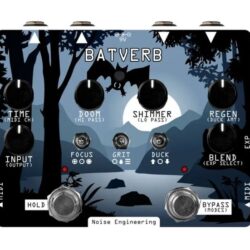
Noise Engineering Batverb Review
When California-based effects company Noise Engineering released their Desmodus Versio in 2020, it represented the first reverb effect in their product line, but they coined a new term for the DSP-based effect: a synthetic-tail generator. The name reflects the reality that it is, by definition, the Desmodus Versio doesn’t create literal reverberation, as in reflections in a room, but instead builds “tails” onto an audio signal. Taxonomy aside, it was a powerful, well-received, and positively jam-packed digital unit.The Batverb, launched earlier this year, is an evolution of Noise’s tail-generating efforts. However, it uses brand-new code programmed for Electrosmith’s Daisy Seed DSP platform. A stereo effect box that spans delightful and demented flavors of delay and reverb, the Batverb is generously featured and full of unique takes on space-making effects. Heads or TailsThe Batverb’s main panel includes six knobs, three 3-way switches, two footswitches, and one “bat” button, which you press and hold to access alternate parameters assigned to the knobs. On the crown are input jacks for either mono or stereo performance as well as MIDI in/out and expression pedal jacks. Up to 16 different presets can be saved and recalled via MIDI.In normal operation, the knobs govern, from bottom left to bottom right, input volume, time, a suboctave chorus, an octave-up shimmer, “regen” or feedback, and a blend of dry and wet signals. When holding the bat button, those same knobs, in order, control output volume, MIDI channel selection, high-pass filter, low-pass filter, duck amount, and expression pedal parameter assignment. The focus switch changes the diffusion of the delay lines. In the left position it behaves more like a delay, while the other two settings sound and feel more like reverbs. Grit adds, in the middle and right positions, a discrete soft-clipping distortion, and duck determines the responsiveness of the feedback. In the switch’s center position, there’s no ducking. At left, feedback monetarily increases when input volume is received, then tapers off as the signal does. At right, the opposite happens, and feedback increases as the signal gets quieter. Enter the Bat CaveTo my ears, the Batverb’s more reverb-y patches are in hall or room territory—albeit very cavernous halls or rooms. But reverb sounds created by the Batverb’s algorithms sound more authentic to me than many sought-after reverbs I’ve played. Rather than an indistinct wash of sound, the tails here give the convincing impression of your amp’s signal ricocheting around a high-ceilinged cathedral, at first coming back in clearer, sharper bursts, then melting into smeary ambience. And the handy hold feature can be engaged for infinite regeneration by tapping the footswitch, or for a specific window by pressing and holding. That double utility goes a long way toward determining whether the Batverb sounds organic or unhinged.The sub- and up-octave content injected by the doom and shimmer knobs is more chaotic and spacious than garden-variety iterations of those effects you’ll find on many octave-based reverbs, and that’s a good thing. Like most effects generated by the Batverb it feels like the product of thoughtful, well-considered programming. The delay algorithm, engaged with the focus toggle at left, is pleasant and plenty usable, and it’s nice to have alongside the less predictable reverb settings. But the Batverb’s deep tweakability means you can still dial in a broad range of both standard and more marginal delay sounds. The chunky transistor-ish dirt summoned by the grit switch widens the palette further. Add in the touch-sensitive ducking (and its customizable parameters), and you’ve got a ton of ground to play with.The VerdictNoise Engineering created an outstanding reverb and tail generator here. Considering its steep asking price, the Batverb will be out of the question for many players, but it’s obviously geared to adventurous players and discerning producers, especially those looking for authentic, parallel universe-conjuring ambience and noise in their studio or live rigs. For these musicians, the Batverb will be more than worth the bite it takes from the bank balance.
Read more »