
The “Stairway” Progression
From the 12-bar blues to a shuffle pattern to a IIm7–V7–I progression, many musical motifs get recycled and repurposed. It’s accepted that these ideas are simply out there in the air for songwriters and composers to use, gratis, as musical building blocks from which to create new work. Right?Maybe not. A few years ago, Led Zeppelin was sued for using one of these common motifs as the basis for “Stairway to Heaven.” I was as surprised as anyone. I’ve been teaching this chromatically descending minor chord progression as an example of a compositional tool for years, citing a series of examples of its use in different situations. But sure enough, the band Spirit had decided to lay claim to the progression.During the trial in 2016, Jimmy Page admitted that his song and Spirit’s “Taurus,” “are very similar because that chord sequence has been around forever.” Back when Page wrote “Stairway” in 1971, he was surely well aware of what he was doing. This chord progression had really been making the rounds in pop culture.I’ve collected quite a few examples of this progression’s usage to show what can be done with this motif, compositionally. These examples prove that this progression is nothing more than a kernel of musical information that songwriters and composers have been using for much longer than “Stairway to Heaven” or “Taurus” have been around.The list below could be much longer, but I’ve edited it down to what I think are the strongest examples, where this motif is used in the most recognizable way, either as the beginning of a song or a section. So, you won’t be seeing “You Are the Sunshine of My Life” by Stevie Wonder or the “Dead Man” theme by Neil Young, but just know that both of those songs are among the many that use this pattern.Because both “Stairway to Heaven” and “Taurus” are in A minor, I’ve decided to transpose all the examples into A minor to make it easy to compare them. But first, let’s hear both “Stairway” and “Taurus.”Stairway to Heaven (Remaster)TaurusIn Ex. 1, we see the opening phrases to both “Stairway to Heaven” and “Taurus.” The first three measures are the only overlap in these phrases. Both songs have a descending bass note that starts on the root of Am, then descends chromatically to F. This bass line creates some interest in what could be a rather stagnant stretch of Am. The F# can be used as either an Am6/F# or a D/F#. Essentially, the difference between names here is based on what else happens harmonically around that chord and for our purposes, we can consider them to be the same chord.Following the F# bass note, both songs have a measure of Fmaj7 and that’s where the commonalities end. “Stairway” follows that with a resolution from G back to A minor, which would be a bVII resolving to a Im, while “Taurus” goes to Dm, which is the IVm chord.If we go way back in time to the 17th century, we find Italian Baroque composer and guitarist Giovanni Battista Granata featuring this motif in his “To Catch a Shad.” In the trial, Led Zeppelin used this song as proof that the chord progression is in the public domain. Shown in Ex. 2, the song uses essentially the same progression as “Stairway to Heaven.” “To Catch a Shad” was covered by the Modern Folk Quartet in 1963.To Catch a ShadFast forwarding to the 20th century, we discover that Irving Berlin used this same motif for the first four measures of his song “Blue Skies” in 1926, shown here in Ex. 3. The progression descends chromatically to a D major chord, then modulates to C major for the next phrase.Thelonious Monk used “Blue Skies” as the basis for his song “In Walked Bud,” first recorded in 1947. The first four measures are essentially the same, followed by a similar turnaround through a sequence of chords in the key of C major.Irving Kaufman – Blue Skies (1927)In Walked BudBoth Duke Ellington and Richard Rodgers used this progression in the 1930s for their respective compositions “In a Sentimental Mood” and “My Funny Valentine.” In Ex. 4, notice how Ellington used the progression, then repeats it up a fourth. The next phrase begins back on the Am chord and resolves to a C major.Rodgers’ “My Funny Valentine” follows the descending line down to F (much like Spirit would later do), and goes to Dm, before a IIm7b5–V7b9 turnaround back to the tonic.The Beatles never shied away from using a clever songwriting maneuver and our progression in this lesson is no exception—just check out Ex. 5. In 1963, they covered the song “A Taste of Honey” on their debut, Please Please Me. Composed in 1960 by Bobby Scott and Ric Marlow for the Broadway play of the same name, the song features a chromatically descending minor progression in the beginning of the verse.This progression must have made its mark on the budding songwriters, because Paul McCartney and John Lennon wrote “Michelle” for 1965’s Rubber Soul and used a two-measure descending minor progression as the intro, followed by a measure of IVm and V.A few years later, George Harrison used the progression in “Something” from 1969’s Abbey Road. This progression occurs in the verse when Harrison sings, “I don’t want to leave her now,” before coming back to the song’s signature turnaround lick. An interesting thing about “Something” is that the verse opens with the same type of harmonic move on a C major chord. So, the first chords are C–Cmaj7–C7.A Taste Of Honey (Remastered 2009)Michelle (Remastered 2009)Something (Remastered 2015)Ex. 6 shows the first phrase of the song “Chim Chim Cher-ee,” written for the 1964 Disney film, Mary Poppins, by brothers Robert B. Sherman and Richard M. Sherman. Heavily covered by jazz artists in the mid ’60s, this song was most certainly floating around in the popular consciousness. The first two measures are followed by a resolution (IVm–Im) and a turnaround (II7–V7).Also from that same year was “War of the Satellites,” written for the Ventures’ In Space record by Danny Hamilton. In this surf rock classic, the descending minor progression is used in A minor, modulates down a whole-step and repeats in G minor, then modulates again to F minor, where it stays momentarily then jumps around chromatically, ascending and descending, before repeating.Mary Poppins – Chim Chim Cher-eeThe Ventures War Of The Satellites (Stereo) (Super Sound)Through these examples, we’ve looked at quite a wide variety of styles, from baroque music to Tin Pan Alley, jazz to surf, show tunes to classic rock. What’s fascinating about all of these examples is the way the songwriters were able to take this common piece of harmonic information, put a unique spin on it, and go in different musical directions.This article was updated on September 20, 2021
Read more »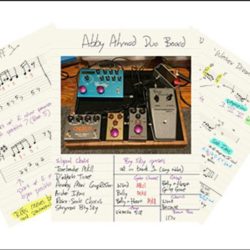
Should You Keep a Guitar Journal?
Last updated on July 22, 2022Musical research is an incredibly important aspect of growing as a musician. We’re already subconsciously absorbing information when we listen to music—even if it’s in the background. Documenting what we’re hearing can really solidify what we take away from the listening experience.As musicians, we are sound. Everything we hear influences us, but the way we collect sounds can resemble how we might collect receipts for tax purposes: They’re just scattered all over the place. If that’s the case, when April comes around you suddenly wish you had a system for finding your receipts, organized by category, in one central location.Our musical minds are similar to our households at tax time. You hear so many musical ideas but they’re completely unorganized. I started thinking about how to categorize my favorite musical ideas because I wanted to collect and record what I found influential. This led me to musical journaling.The Musical JournalMy musical journal is a notebook where I write down musical ideas that I find appealing. I don’t make full song transcriptions. Instead, I highlight small phrases, a progression, or other details about a song. I make notes about how they work and what I like about them.It’s less a personal Real Book and more of a recipe book. When most musicians transcribe, they often notate much longer sections or ideas. My musical journals are filled with smaller snapshots.The GoalMy goal is to have a physical reference of ideas that inspire and appeal to me. I consult the journal when I need to play a certain style of music or jump-start some creativity. Musical styles tend to have specific elements and if you want to get deep into a style, you must get good at recognizing its traits.For instance, I have a journal on punk music. It includes notes on my favorite punk songs from the Buzzcocks, the Clash, the Ramones, the Germs, the Dead Kennedys, Minor Threat, and Black Flag, to name just a few. When I need to play a punk gig or session, or want to compose in that style, I’ll go through my punk journal to see what progressions or chord shapes are common. Punk music uses a lot of full barre chords. If you play the right punk chords with the wrong voicings, it won’t sound like punk.Different JournalsBack to organization. I keep a different journal for each style of music I’m researching. I have one for funk that includes songs by the Meters, Funkadelic, and Sly Stone. I have another for blues with research on Howlin’ Wolf, Mississippi John Hurt, Bukka White, Muddy Waters, and others.Because I listen to and am asked to play different styles of music, my research tends to be broad. Although I would encourage you to listen to many different types of music, it’s not necessary to journal about everything you hear.Here are just a few examples of things I like to include in my journals.Song Tempo Many musicians don’t make notes on song tempos, yet the tempo is incredibly important to the feel of a song. Changing a tempo by merely 2 bpm can greatly alter its sound and feel. If you study a specific style of music, you may also notice that a lot of it lives in a tempo neighborhood. Being aware of this can deepen your playing. In Fig. 1, you can see a page out of my journal about a song called “Western Dream.”Chord Cycles When researching styles of music, you will find similar chord cycles. Musical styles are like families, and chord progressions typically have a direct relationship to other songs in that genre. You’ll see a lot of I–IV–V progressions in the blues, for example.Riffs Guitar riffs also tend to get recycled. As with chord progressions, it might not be the identical riff, but it may sit in a similar position and use a closely related collection of notes.Understanding these riff positions or collections is important. For instance, I’ve seen a lot of guitarists who study blues play the correct notes, but in the wrong position. Why does this matter? For one thing, the note’s timbre can be different, depending on what string it’s played on. For another, the position and fingering give you access to certain expressions like bends, hammer-ons, and pull-offs.When I’m journaling, I note the position the riff is played in (Fig. 2). And it may vary considerably from where I play a similar riff in a different genre.MelodyI know I just talked about positions and fingering, but I think too many guitarists look at music as a matter of positions on the fretboard. I can’t stress enough the importance of melody. One of my favorite things to do with students is to study the melody line of a song. It’s great for building good soloing skills.Melody lines often give you everything you need to create a tasteful solo. Sometimes I’ll journal a melody line to a verse or chorus (Fig. 3). Then I’ll make notes about the melody’s relationship to the chords. Does it start on the 3 of the chord? Are there any interesting color notes in there that stick out to you?It’s a great idea to take note of these things. These are sounds you might like to use in a different song. Understanding the melody’s relationship to the chord is vital: Don’t look at notes and positions in isolation, but rather in a melodic context. You only truly understand the flavor of a note when it’s set against another note or a chord. These are like flavor pairings. Just as some pair white wine with fish, you may pair an E note in a melody with a C chord.FormAnother corner guitarists paint themselves into relates to understanding song form. Many players start by learning sections of songs, but if you’re not looking at the whole form of a song, you’re seeing an incomplete picture.Form dictates many musical decisions. You can’t fully understand why some of these decisions were made unless you look at the song as a whole. I mentioned not transcribing full songs in my journal, but I do mark out the form for reference and make mention of songs that have an unusual layout.Consider “I Wanna Be Sedated” by the Ramones. It modulates up a whole-step after the first chorus. This is an interesting move—not many songs modulate that early.ToolsThere are several ways you can approach journaling. For instance, you can use a traditional notebook. I used to pursue journaling like an arts-and-crafts project. I had blank sheets of music paper and a wire-bound notebook. I’d notate a musical idea on the sheet music, cut it out, tape it into the notebook, and then write my notes around it.I found this somewhat meditative. It forced me to take time to write it, cut it out, and tape it. I’d think about the music more before moving onto something else. Each entry wasn’t a brief moment, but rather a process to be experienced.And although I liked it, it was a little difficult to do consistently on tour. I needed to have a book bag with several notebooks, scissors, tape, and blank music paper. I’d sit in my hotel room and research music and make a mess.To reduce what I needed to carry around, I moved to an iPad. There is a wonderful app for the iPad called GoodNotes. It includes templates for sheet music, tabs, and ruled paper. It allows me to have a collection of journals, just as I would with a notebook. I can create a transcription and cut and paste it in my journal. I can write notes in different colors and highlight them.Memory ManI’ve always been fascinated with music, but my memory isn’t always the best. I can remember songs on tour and during a session, but fishing a song or idea out of my memory archives can be a little time-consuming. That’s why I always have my research with me: If I’m on a session and ask to play a reggae-like single-note line, I can open up my notes on reggae and check out my Max Romeo research.Reading MusicYou don’t have to read music to keep an effective music journal. It doesn’t matter so much how you make your notes as long, as they are well-documented and clear, and make sense to you.I personally like reading music and understanding music theory. Which isn’t a surprise, since I wrote a book on the subject called Practice Makes Progress. It helps me understand and recall things more quickly. I can spot similarities and apply them to other situations more effectively. I don’t use theory to create music, just to connect a few dots.SoundsIt’s also a great idea to include a song’s sounds in your journal notes. Is there a wah? A specific fuzz tone? A particular guitar or pickup position? I write down these tone recipes for future reference.Gig JournalOn the subject of sounds, I also journal about guitar rigs for the various gigs I do. Taking pictures of pedalboards, amp settings, and guitars can really help you get back up to speed on a gig you haven’t played in a bit. Guitarists tend to be a tweaky bunch. We’re always trying new pedals and messing with settings, but sometimes we need to turn back the clock.I don’t know about you, but I can’t remember what I used two gigs ago, let alone four or five. I play with a lot of artists and do a wide variety of sessions. Each of these gigs has very specific tone collection and I don’t use the same gear for every gig. I can either scratch my head for an hour or take one minute and look at my notes. I will also include notes on what presets I used for which song. If you haven’t been gigging regularly with a particular artist or band, don’t expect you’ll remember preset six for the fourth song in the set in eight months ago.Fig. 4 is a page from my journal for Amy Helm. I tour with Amy a lot, but sometimes we have a few weeks off. During this hiatus, I’m likely to change pedals and do different gigs. Even if I know what pedals I used on an Amy’ gig, I still might not remember the exact settings on my Vick Audio ’73 Rams Head. Tracking down a photo in my photo library can also be tricky.In the break from the last Amy Helm tour I played a gig with songwriter Abby Ahmad (who also happens to be my wife). They may share a few pedals, but it’s a very different sound and approach (Fig. 5). Having some assistance with gig recall allows you to make more music, more confidently.Okay, now I think you have some work to do.
Read more »